Apr 1, 2013

From VideoNuze - Aereo: The Hands On Review


I’ve been testing out Aereo for the past two weeks (see video above), ever since they expanded their service area to include the entire New York metropolitan area. I tested it at home where I have a blazing fast 50 Mbps FIOS connection using both their new Roku app and my iPad 3, and outside the house, where I rely on a Verizon Wireless iPhone 5 with 4G service. (Well, when 4G is available, that is.) 
Interface: The interface on the iPad and iPhone are fairly similar. There aren’t that many channels: Aereo has fleshed out the over-the-air offering with iON and a couple of foreign-language offerings, but most users are going to be looking for content from the Big 4 networks and PBS. On the Roku app, the channels are arranged in Roku’s linear filmstrip layout, so that getting from one end to the other is quite a hassle. 
Changing the Channel: This is Aereo’s biggest fail: changing the channel is a monumental hassle on all their devices. On the iPad or iPhone, it’s a multi-step process: Minimize the screen, hit “done”, go back to the channel guide, find the channel you want to switch to, go to that channel’s screen, hit “play” (versus “record”), go to the first screen, maximize the video.
READ THE REST AT VIDEONUZE

Mar 26, 2013

From NPR: Why Are TV Remotes So Terrible?


I made my debut on NPR this morning, and part of Neda Ulaby's piece on the issues that are holding back tech advances in the TV industry.


Let's call it the baby sitter's dilemma.
If you go to someone's house and pick up the TV remote, chances are, you won't know how it works. You know the situation's bad when even a tech writer who also majored in physics at an Ivy League school is confused by her own TV remote.
"It's unbearable to me," moans Ars Technica writer Casey Johnston, of her remote's many cryptic buttons. "Sub.code? Comp/mix? I couldn't even tell you what one of those things do, but then assign them to the same button? It just doesn't make any sense."
So why, at a moment when both technology and TV shows are so terrific, are interfaces so clumsy and counterintuitive? 
By interfaces, I mean both the actual, super-inscrutable remote controls and the unwieldy grid on our screens that many of us are forced to navigate to find what we want to watch.
And I have to confess the entire idea for this piece was inspired by Alan Wolk. His official title is global lead analyst at KIT Digital, and he writes a terrific blog called The Toad Stool. That's where I read his essay, "The TV Business: A Primer For The Uninformed," which elegantly points out how inelegant our TV interfaces are.
READ THE REST AND HEAR THE INTERVIEW AT NPR.ORG 


Mar 20, 2013

New On Digiday: Second Screen Is Not Social TV


While the terms “social TV” and “second screen” are often used interchangeably, they are, in fact, two different experiences: Social TV is a subset of second screen — and a somewhat minor one at that.  
As technology and adoption advance, every show will need to come up with its own unique spin on what constitutes valuable second-screen content. For a baseball game, it may be a very graphics-intensive take on statistics; for a reality game show, it may be online voting. Those decisions are up to the networks and the individual show runners, who’ll need to balance their goals (e.g., increase tune-in or cement loyalty) with what their budget allows.  
READ THE REST AT DIGIDAY.COM

Mar 14, 2013

From The Guardian: Beyond Apps: The Future of Smart TV

I have my first piece in The Guardian this week, the UK's leading newspaper and quite possibly the world's.

It's a big leap forward in terms of reach and I'm extremely psyched about it.


2012 Consumer Electronics Show Showcases Latest Technology Innovations
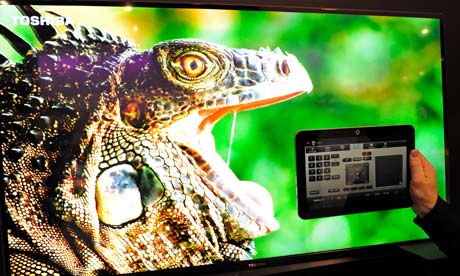
A smart TV's connected features can be controlled from a second screen, creating many different commercial possibilities. Photograph: Ethan Miller/Getty Images
A recent study by the NPD Group showed that more than 40% of households with smart TVs have never actually bothered to hook them up to the internet. However, given the state of the interface found on most smart TVs, this should come as no surprise.
TV manufacturers got it into their heads that users might like an easy way to connect to Netflix. Which was not a bad idea. If only they'd stopped there. Instead, they turned the screen into a Compuserve 1993 concoction of random apps, few of which had anything to do with television...

READ THE REST AT THE GUARDIAN

Mar 1, 2013

Beet Retreat Interview #2: TV Everywhere

This is the second of three interviews I did during the Beet TV Executive Retreat - this one is on TV Everywhere.

As an indication of how fast the industry is moving, although we filmed this about 3 weeks ago, in the intervening period, Nielsen announced that they would soon begin counting views on iPads, Xboxes and other non-TV devices.

Since that was the crux of the network's objections to TV Everywhere (the fact that they'd lose ad revenue when people watched remotely on a iPad) it would seem to give a green light for a renewed push. One that may have the full cooperation of the networks, or at least their tacit blessing.


Read the full interview and story and Beet.tv

Feb 27, 2013

The Meteor Cometh


So for a long time, we’ve been talking about the mythical meteor that was going to hit the TV industry and wipe out all the dinosaurs. Because there didn’t seem to be a logical out to the situation we were in, where everyone was making money and no one wanted to rock the status quo. Which left prognosticators like me talking about the meteor, the “something” that would happen and cause change in the industry. Only we couldn't figure out where that meteor would come from or what it would look like.

Then suddenly this morning, the meteor appeared.

I’m talking about the lawsuit that Cablevision filed, asking the court to void the late 2012 carriage agreement they signed with Viacom because Viacom had “coerced them” by “threatening to impose massive financial penalties” unless they complied with Viacom's demands."

There’s a wonderful irony in this too, given that it was Viacom who successfully shut down Cablevision’s TV Everywhere play back in 2011. 

But I digress.

The “why” isn’t hard to get: the MVPDs hear all the consumer complaints about bundling and they’re tired of getting blamed for it. It’s an odd thing: the networks are quite teflon when it comes to the viewing public, who blame the MVPDs for forcing them to take thousand channel bundles without ever considering that their existence is purely the doing of the networks, whose carriage deals leave the MVPDs with no other option.

And so after years of handwringing about how and where the first crack was going to be, who was going to "cave" and let the barbarians into Rome, it now seems that the answer is the Federal court system (and likely the Supreme Court itself, as neither side is likely to go down easily.) They will be the ones who step in and save the TV industry from itself. 

And if and when they do decide that forcing bundles on MVPDs is a bad thing, that will indeed be the moment the meteor falls and kills the dinosaurs and busts the industry wide open so that Apple TV and beautiful, personalized interfaces and cloud-based DVRs and dozens of other magical things we can now do with our televisions come to life and start populating the ecosystem like mammals who no longer need fear being chomped on by a tyrannosaurus every time they pop their tiny little heads out of their holes.

Only don’t hold your breath: it takes a while for a case like this to make its way to the Supreme Court. So that meteor’s not striking tomorrow.

Popcorn Moment: while you’re watching the festivities unfold, keep your eye out for whether any of the other networks or MVPDs jump in and join the fray. It’s in the network’s interest to keep things mano a mano, since if all the MVPDs join in and turn this into TV’s version of the Great War, public opinion is sure to be with the MVPDs and the forces of anti-bundling.

Once again, it’s time to sit back and enjoy the show.


Feb 25, 2013

The Problem With Facebook Data


The more I use Facebook Graph Search, the more evident it becomes that Facebook made a major mistake with their most ubiquitous feature: the “Like.”

Follow this train: Facebook’s value, their kryptonite, is their data. They have a billion users, and they know the habits and preferences of all of billion of them because they can easily track that information by examining what they’ve Liked.

Or can they?

On the pre-Like Facebook, users were Fans of pages. That information - which brands, bands, books, movies, sports teams, etc. a user was a Fan of was prominently displayed on the user’s profile page. Which meant users spent a lot of time curating those selections, pruning and adding so that the list was an accurate reflection of who they were. Or at least who they wanted people to think they were.

As a result, it was tough (or tough-ish) to get users to become fans of pages they didn’t think would give them social currency or look good on their wall. Hence, the Like, an easy way to give a brand a thumbs-up (and permission to coat your wall with brand messages.)

But while the Like button has become ubiquitous and a seeming smash hit for Facebook, it does not appear to be used in any consistent manner. That was its selling point: a lower key way for users to indicate approval for a brand, but it’s also it’s Achille’s heel: if users aren’t displaying any sort of consistency in the way they use the like button, then the resulting data is fairly inaccurate and not all that useful. (Bye-bye monetization.)

This is evident in the spate of Tumblr blogs flagging the random overlaps Facebook Graph Search pulls up (married men who like prostitutes, Christians who like porn) and in less quirky uses, like the study BTIG did on the accuracy of using Graph Search as a movie recommendation engine. What they found should be somewhat troubling for Facebook: the movies users Liked overwhelmingly dated back to the list they compiled when they first signed up for the service or to the last used the Fan format.

There are multiple reasons users are either promiscuous or inconsistent with their Likes, but they all circle around two competing forces: (A) If The Brands We Like are how we present ourselves to the world, it takes a lot for a new brand to crack that list and (B) if Likes are easy to give and easily buried in the News Feed, there’s no reason not to give them out at random.

Now by brands, I mean any sort of product: movies, books, songs, actors, vacation spots, along with the more typical products and services we call brands. To the consumer, they’re all a part of who they are, and attaching their name to anything other than the tried and true, when that preference is in a prominent location, is a leap.

The constant rejiggering of the Facebook interface - particularly the introduction of the Timeline, where the “About” section, with the brands and media the user likes, is now one level down-- has lessened the amount of attention people give to their Likes. That in turn, works on the validity of Likes from another direction: those who don’t see their Likes as a reflection of who they are are likely to become more promiscuous with them, and at the same time more random, on the assumption that the action has both an immediate value (unlocking a coupon offer) and limited aftereffects.

The other culprit here, perhaps even more to blame than Timeline is Frictionless Sharing: by posting every article the user half-glanced at and every song they or their offspring started to listen to, Frictionless Sharing greatly reduced the impetus the user had to be sparing with their Likes. While “Mary is listening to Ruby Tuesday by the Rolling Stones on Spotify” was supposed to be of lesser significance than “Mary Liked Ruby Tuesday by the Rolling Stones,” users did not really grasp that subtlety and many likely figured that if all bets were off, why not just start Liking just about everything?

While it’s possible to imagine a scenario where Facebook encourages users to carefully parse out Likes to new products so that their opinions can help guide their friends, it seems unlikely:  first and foremost there is the black and white nature of the Like: it’s an endorsement, pure and simple, in the way that 3 stars out of 5 is not.

Can Facebook fix this? Probably. They’ll need to rethink both the Like and frictionless sharing and the value users place on having their brand and media preferences prominently featured on their profiles. If they can solve for that in a way that encourages more, rather than less interaction, and more curation of the brands (media and otherwise) a user Likes, they have a good chance to make their data more accurate and thus, more valuable.

The stakes are high, and it’s a big “if.”

Feb 19, 2013

Talking TV On The TV: My Debut On The Brian Lehrer Show


Me, Natan Edelsburg from Lost Remote and TV critic Eric Deggans discussing the impact of House of Cards, Netflix in general and the future of television overall.

The clip starts at 30 minutes and 30 seconds in.